Farafra region · chalk and starlight
White Desert after dark
When the sun leaves, pale formations do not disappear at the same rate as the ground around them. The landscape becomes a lesson in reflected light, uncertain scale and the patience required to see.
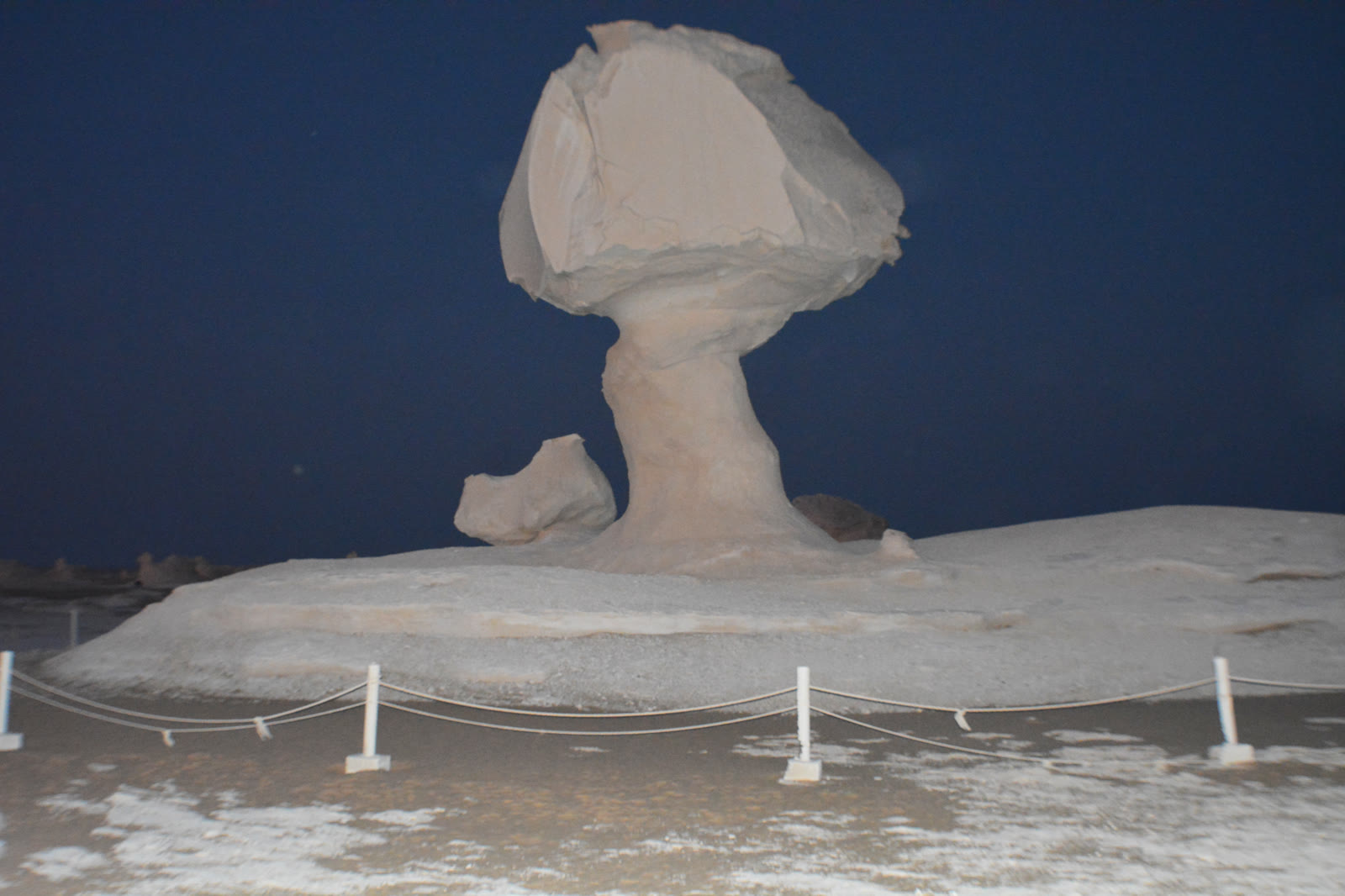
White is a relative colour
The White Desert is known for chalk and limestone formations shaped by erosion into towers, caps, ridges and forms that invite human comparisons. In hard daylight their whiteness can appear nearly absolute. At dusk, the same surfaces reveal that “white” is a relationship. A face turned toward the remaining sky holds cool light; a face turned away becomes grey; an undercut collapses quickly into shadow.
Choose one formation before the light fades and trace these changes. Do not search immediately for another landmark. Watch the bright side lose colour, then notice whether its outline remains legible after the surrounding ground no longer does. Pale stone can seem to float because the visual connection to its base has vanished.
Scale becomes unreliable
Desert distance is difficult even in daylight. Sparse reference points make it hard to judge whether a formation is modest and close or large and far away. Low light removes more evidence. Texture disappears, the horizon softens and shadows join separate pieces of ground into a single dark plane.
This is visually compelling but practically important. Never let curiosity about scale pull you away from an established, legitimate stopping place. The safest reading position is one chosen with current local guidance while orientation remains easy. Once there, use a known object in the foreground—a vehicle only where appropriately parked, a fixed track edge, or the silhouette of your immediate group—to understand relative size without wandering.
Darkness simplifies the photograph while making the real ground more complicated.
Stars arrive by degrees
The first visible point of light is not the beginning of full darkness. Twilight is a sequence, and the eye adapts throughout it. A bright phone screen interrupts that adaptation. If light is needed for a safe task, keep it low, directed and no brighter than necessary. Safety takes priority over dark adaptation, but careless light does not.
As more stars become visible, compare the sky close to the horizon with the sky overhead. Atmospheric dust, moisture, moonlight and distant artificial light can reduce contrast near the edge. A truly dark-looking photograph may also be the result of exposure choices that differ from human vision. Appreciate the image without treating it as a forecast for a future night.
Moonlight rewrites the forms
A moonlit White Desert is not simply a brighter version of a moonless one. Directional moonlight can cast long shadows, sharpen ridges and reduce the number of faint stars visible. A darker sky may reveal more stars but less detail on the ground. Neither condition is automatically superior; each produces a different landscape.
If lunar phase matters to your purpose, consult a reliable astronomical source for the date and location. Then check local weather and access information separately. Phase alone cannot predict haze, cloud, wind, route condition or whether entry is appropriate.
Sound redraws the distance
When visual detail recedes, sound becomes a second map. A voice that seemed nearby in daylight may carry much farther across open ground; a vehicle can be heard before its position is clear; wind changes around the lee side of a formation. Listen without using sound as a reason to investigate. Direction and distance are easily misread in open terrain.
A short period of quiet also reveals the effect of your own group. Lower conversation and equipment noise, where appropriate, and the scene becomes larger. This is another reason to stay fixed: hearing the landscape change does not require leaving the known ground.
A fixed-frame exercise
- Select one formation before sunset and remain at a legitimate observation point.
- Note which surface loses warmth first and which outline survives longest.
- Allow your vision to adapt without repeatedly checking a bright display.
- Compare the apparent sky in person with any long-exposure image later.
The protected landscape comes first
The White Desert is a protected environment, not an open studio without limits. Current route, permit, guiding, camping and conservation requirements must come from the responsible Egyptian authorities and legitimate experienced local providers. Do not infer permission from old reports, tyre tracks or social media images.
A meaningful night observation can be small: one chalk form, one changing edge, one period of quiet. Leave geological features untouched, keep waste contained and avoid adding unnecessary light or noise. The reward of darkness is not possession of a remote scene; it is a temporary, careful way of seeing it.

