Luxor · water and silhouette
Nile blue hour
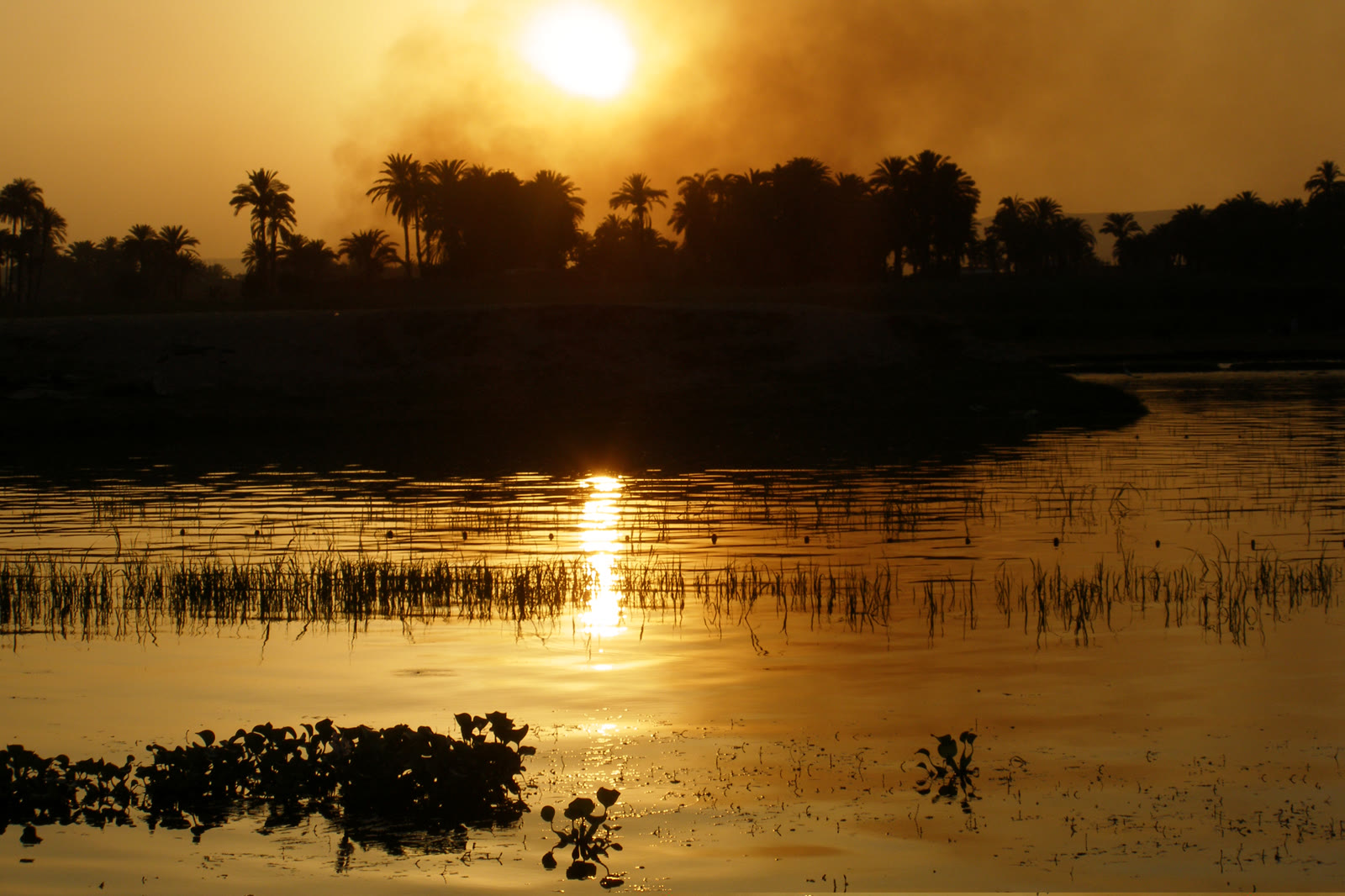
Sunset is an event on the horizon. Blue hour is a condition across the whole scene: sky and river cool together while boats, palms and banks become a dark, moving notation.
Stay after the orange
A river sunset naturally pulls attention toward the brightest colour. The sun approaches the bank, warm light spreads across the water and silhouettes become dramatic. When the disc is gone, many observers turn away. That is precisely when another phase begins.
Blue hour is not a fixed minute and does not always look intensely blue. It describes a period of twilight when indirect light from the sky dominates the scene. Around Luxor, dust, haze, cloud and season can push the colour toward violet, grey or muted teal. The useful practice is not to demand a particular hue but to watch the balance change between sky and land.
The river doubles the sky
Water keeps a broad area of the scene luminous. A dark bank may occupy the middle of the frame while reflected sky continues below it. Ripples break the reflection into horizontal marks; a smooth section stretches colour into a quieter field. A passing boat folds both effects together.
Look for the difference between reflected brightness and reflected detail. You may see light without a readable image of clouds or palms. Change your angle slightly and the reflection changes, because water returns light directionally. This is why two people a few metres apart can experience different bands of colour.
The Nile does not simply mirror twilight. It edits the sky into movement.
Silhouette is information
As direct light falls, the west bank, vegetation and vessels lose surface detail. Their outlines become more important. Palms identify themselves through crown shape; a felucca or small craft may be recognized by mast, hull or sail; buildings combine into a continuous edge.
Do not assume a silhouette is empty. It describes height, rhythm and interruption. Follow one bank horizontally and note every place the outline rises or opens. The exercise makes a familiar sunset more geographic: the river is no longer only foreground to the sky, but a channel between differently shaped edges.
Movement sets the clock
On land, fading light can feel gradual. Boats make the transition easier to perceive. A hull that was clearly coloured becomes dark; a wake first shines, then blends into the water; navigation or city lights become more visually dominant. These changes provide a human timescale inside an astronomical one.
If you are on a boat, current safety instructions and the operator's judgement matter more than obtaining a view. If you are on the waterfront, remain in legitimate public areas and protect the return route as visibility decreases. This publication neither arranges river trips nor verifies mooring, crossing or promenade conditions.
Wind changes the surface
A perfectly smooth reflection is only one river condition. Breeze breaks long colour fields into many short highlights and can make the dark water easier to read as a moving surface. Compare a sheltered strip close to the bank with more open water. The two may carry the same sky in different visual languages.
Wind also affects sound and comfort. Sails, engines, voices and water against a hull arrive differently as the air shifts. Let those cues keep the scene physical. Blue hour is not a colour filter placed over the Nile; it is a changing river environment in which light is only one variable.
A twenty-minute observation
- Choose one stable section of bank before the sun disappears.
- Notice when colour detail leaves the land but remains in the water.
- Track one boat or moving reflection without changing position.
- Finish by identifying the brightest remaining surface that is not an artificial light.
Artificial light enters the composition
Blue hour ends gradually as electric lights begin to dominate. A warm lamp on a boat or along the bank can appear stronger than it is because the surrounding scene has darkened. Its reflection may create a vertical accent against the river's horizontal movement.
This is a useful moment to stop rather than extend the route impulsively. Confirm onward transport in advance, keep water edges in mind and do not sacrifice situational awareness to a screen or camera. The Nile at dusk rewards a fixed, secure viewpoint. The scene moves for you: water passes, boats cross and the sky withdraws without any need to chase it.

